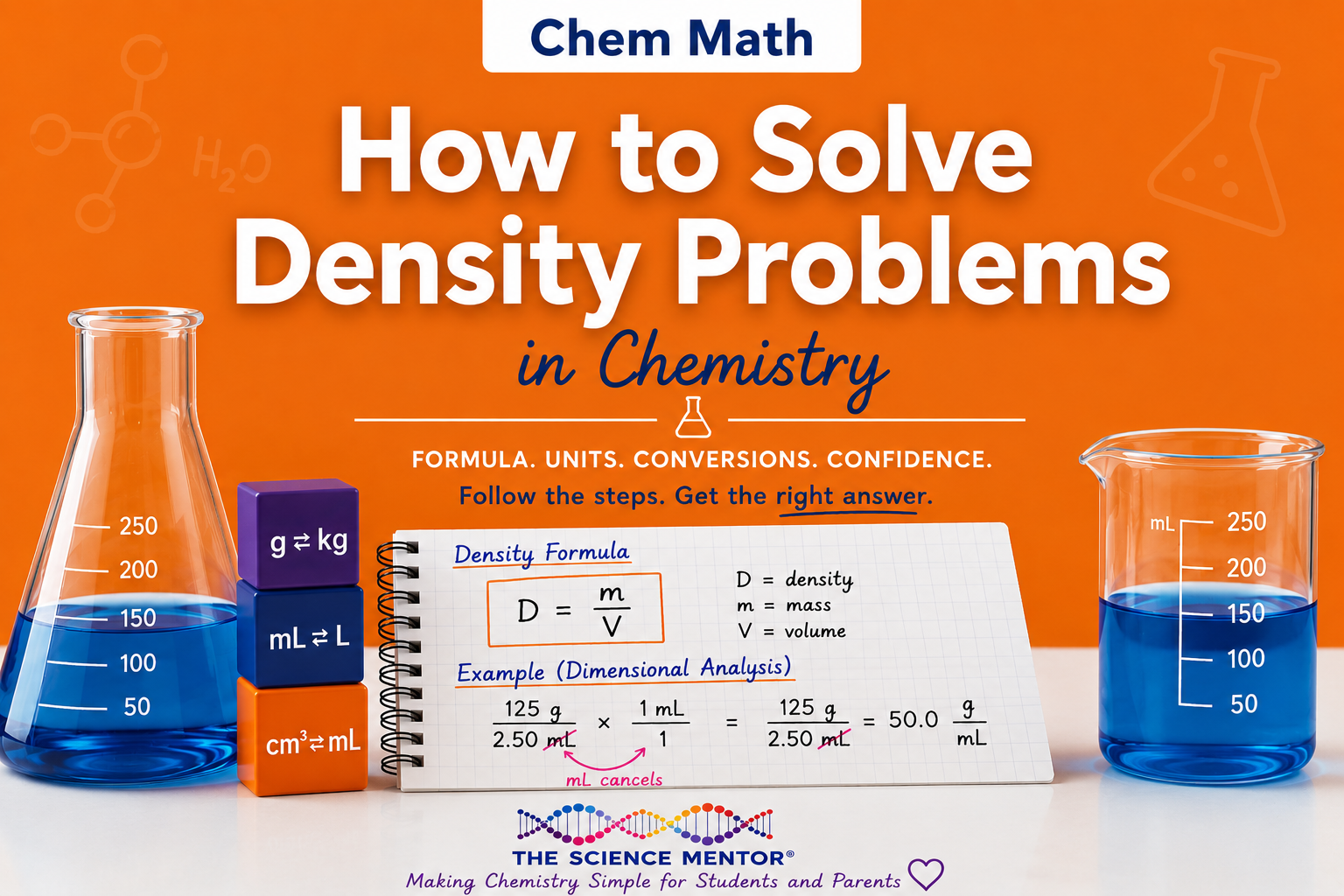
How to Solve Density Problems
Learning how to solve density problems in chemistry brings several of the math skills students have been practicing together.
You have a formula, units to keep track of, and sometimes an equation that needs to be rearranged before you can solve. On top of that, the units you are given may not even be the units you need.
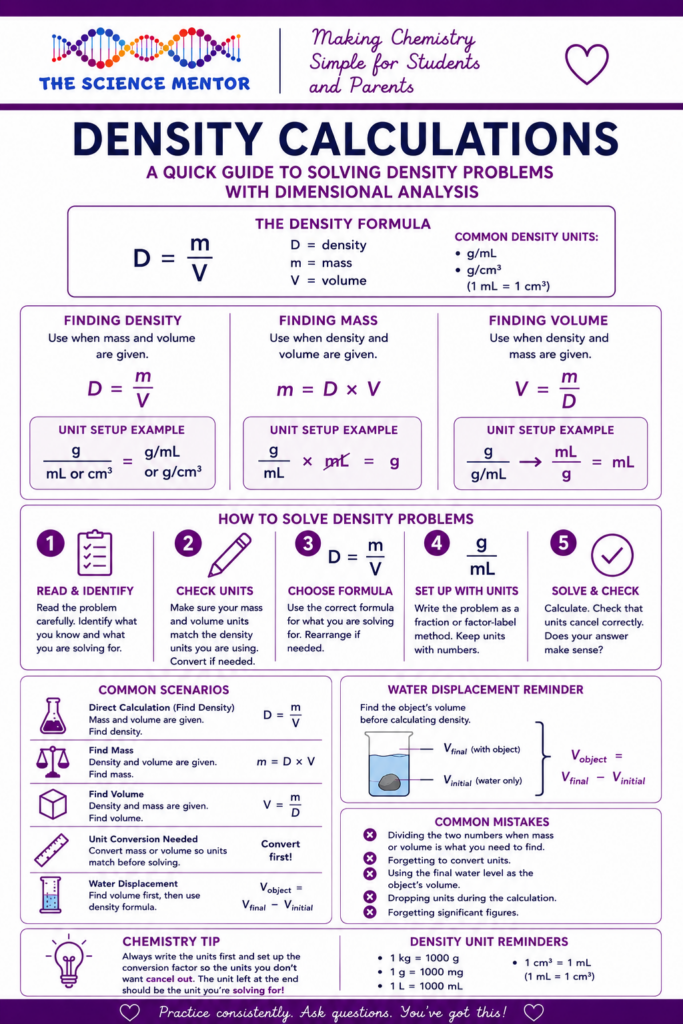
The density formula itself is not difficult:
Density = mass ÷ volume
The harder part is figuring out what the problem is asking you to find and what needs to happen before you start calculating.
This blog is the fourth in my chemistry math series. If you have been working through the series, we are going to use some of those dimensional analysis and metric conversion skills again here, but this time we are putting them to work in actual chemistry problems.
Let’s work through it.
What Does Density Tell Us?
Density tells us how much mass is packed into a certain amount of space.
Think about a kilogram of feathers and a kilogram of lead. They have the same mass, but they certainly do not take up the same amount of space. The lead packs that mass into a much smaller volume, which means it has a greater density.
In chemistry, density is commonly measured in
g/mL for liquids
g/cm³ for solids
Notice that both units are fractions.
Density is a relationship between mass and volume, so the mass unit belongs in the numerator, and the volume unit belongs in the denominator.
Keeping that relationship in fraction format will become important when we start solving problems.
The Density Formula
The density equation is:
where D = density, m = mass, and V = volume.
Students often learn this formula and immediately assume every density problem is asking them to find density. It is not. You may be asked to find density, mass, or volume.
So before plugging anything into the equation, ask:
What am I actually solving for?
That one question can save you from quite a few mistakes.
Example 1: Finding Density
When students first learn how to solve density problems, finding density when mass and volume are already given is the best place to start.
Problem: A sample has a mass of 42.0 g and a volume of 15.0 mL. What is its density?
Step 1: Identify What You Know
Mass = 42.0 g
Volume = 15.0 mL
We are looking for density.
Step 2: Write the Equation
Step 3: Substitute the Values
Keep the division in fraction format and keep the units with the numbers.
This is important.
The units are part of the calculation. Do not drop them just because you have started doing the math.
Step 4: Solve
Answer
Does the Answer Make Sense?
Yes. Our density unit is g/mL, which tells us exactly what we calculated: grams of mass for every milliliter of volume.
Before moving on, check the significant figures too. Both measurements have three significant figures, so our answer should have three significant figures.
Density Problems Do Not Always Ask for Density
Once students understand how to solve density problems when density is the unknown, the problems begin to change.
If the problem gives you density, density is not what you are looking for. This is where the algebra you learned before chemistry comes right back: you need to rearrange the equation.
Example 2: Finding Mass
Problem: A liquid has a density of 1.20 g/mL and a volume of 35.0 mL. What is the mass of the liquid?
Step 1: Identify What You Know
Density = 1.20 g/mL
Volume = 35.0 mL
We are looking for mass.
Step 2: Write the Equation
Start with:
We need to isolate m.
Multiply both sides by volume:
Step 3: Substitute the Values
Write the density as a fraction so you can see what happens to the units.
The mL units cancel, leaving g.
Answer
Does the Answer Make Sense?
Yes. We were solving for mass, and our final unit is grams. This is one reason I want students to keep the units throughout the calculation. They give you a way to check your setup before you finish the math.
Example 3: Finding Volume
Problem: A metal sample has a mass of 54.0 g and a density of 6.00 g/cm³. What is the volume of the sample?
Step 1: Identify What You Know
Mass = 54.0 g
Density = 6.00 g/cm³
We are looking for volume.
Step 2: Write and Rearrange the Equation
Start with:
This time, we need to isolate V.
Rearrange the equation:
Step 3: Substitute the Values
Density is already a fraction, so keep that relationship visible.
Dividing by a fraction is the same as multiplying by its reciprocal:
The grams cancel, leaving cm³.
Answer
Does the Answer Make Sense?
Yes. We were solving for volume, and cm³ is a unit of volume. The units confirm that we rearranged and solved the equation correctly.
When the Units Do Not Match
Learning how to solve density problems also means recognizing when you need a unit conversion before you can use the density equation.
For example, if you need density in g/mL, your mass needs to be in grams, and your volume needs to be in milliliters. If the problem gives you kilograms instead of grams, convert first.
This is an easy place to get an answer that looks reasonable but is completely wrong, so always check the units before you start calculating.
Example 4: Density With a Unit Conversion
Problem: A liquid has a mass of 0.625 kg and a volume of 500.0 mL. What is its density in g/mL?
We cannot put 0.625 kg directly into an equation when we need our density in g/mL.
First, we need to convert kilograms to grams.
Step 1: Convert the Mass
We know 1 kg = 1,000 g. Set up the conversion so kilograms cancel.
Now our units match what we need.
Step 2: Identify What You Know
Mass = 625 g
Volume = 500.0 mL
We are looking for density.
Step 3: Write the Equation
Step 4: Substitute and Solve
Answer
Does the Answer Make Sense?
Yes. The problem asked for g/mL, and that is the unit we have.
The important part of this problem was not the division. It was recognizing that the units needed to be fixed before using the density equation. That is exactly why metric conversions keep showing up in chemistry.
Finding Volume With Water Displacement
Not every density problem gives you the volume directly. For an irregular solid, you may need to determine its volume using water displacement.
When an object is placed into a graduated cylinder, the water level rises. The difference between the final and initial water levels gives you the volume of the object.
Once you have the object’s volume, you can use it in the density equation.
Example 5: Density Using Water Displacement
Problem: A metal sample has a mass of 72.0 g. The water in a graduated cylinder begins at 25.0 mL. After the metal is added, the water level rises to 33.0 mL. What is the density of the metal?
There is an extra step here.
We do not know the volume of the metal yet.
Step 1: Find the Volume of the Metal
Final volume = 33.0 mL
Initial volume = 25.0 mL
Now we have the volume we need.
Step 2: Identify the Density Information
Mass = 72.0 g
Volume = 8.0 mL
We are looking for density.
Step 3: Write the Equation
Step 4: Substitute and Solve
Answer
Does the Answer Make Sense?
Yes. The important part here was recognizing that 33.0 mL is not the volume of the metal. We had to subtract the initial water level first.
That is a common place for students to move too quickly through a density problem.
Putting It All Together
Learning how to solve density problems in chemistry involves more than memorizing one formula. A problem may require you to identify the unknown, rearrange an equation, convert units, and then calculate.
Let’s put several of those skills together.
Problem: A liquid has a density of 0.850 g/mL. What volume in liters would have a mass of 425 g?
We have density and mass, but we need volume in liters. That means this problem will require more than one step
Step 1: Identify What You Know
Density = 0.850 g/mL
Mass = 425 g
We are looking for volume in liters.
Step 2: Rearrange the Density Equation
Start with:
Solve for volume:
Step 3: Substitute the Values
Keep density in fraction format.
Rewrite the division as multiplication by the reciprocal:
The g units cancel, leaving mL.
But we are not finished. The problem asks for liters.
Step 4: Convert Milliliters to Liters
Using 1,000 mL = 1 L:
The mL units cancel, leaving L.
Answer
Does the Answer Make Sense?
Yes. We found volume first, but then we checked the question and saw that our answer was still in the wrong unit.
This problem pulled several skills together: rearranging an equation, keeping track of units, using dimensional analysis, and completing a metric conversion. This is what chemistry math begins to look like as you move further into the course.
Common Mistakes When Solving Density Problems
Automatically dividing the two numbers.
You only divide mass by volume when you are solving for density. If the problem asks for mass or volume, rearrange the equation first.
Ignoring the units.
If density is in g/mL but mass is in kg, those values are not ready to use together. Convert first. Do not assume the calculator will somehow fix the units for you. It won’t.
Using the final water level as the object’s volume.
With water displacement, subtract the initial water level from the final water level before calculating density.
Dropping the units during the calculation.
Keep the units with the numbers. If they cancel correctly, they help confirm that your setup makes sense. If they do not, stop before calculating and check your setup.
Forgetting significant figures.
Once you solve the problem, check the measurements you were given and report your answer with the correct number of significant figures.
How to Check Your Density Answer
Before moving on, ask yourself three questions:
What was I solving for?
Your final unit should match the quantity you were asked to find. Density should have units such as g/mL or g/cm³, mass should have a mass unit such as g, and volume should have a unit such as mL, L, or cm³.
Did my units cancel correctly?
If they did not, go back to your setup before reaching for the calculator.
Does my answer make sense?
Do not skip this one. A calculator will give you an answer even when you set the problem up incorrectly. Your units and your reasoning are what help you catch the mistake.
Why Density Is an Important Chemistry Skill
Density is usually one of the first formulas students use in chemistry, but look at how much math we actually used to solve these problems. We rearranged equations, converted units, used dimensional analysis, worked with significant figures, and had to decide what each problem was asking before doing any of it.
That is why learning how to solve density problems in chemistry matters beyond the density unit. These same skills are going to show up again as the chemistry gets more complicated.
Continue the Chemistry Math Series
Chemistry Calculations Made Simple
This blog is part of a chemistry math series that works through the calculations students use throughout high school chemistry. Each blog focuses on one type of problem and shows students how to work through it step by step.
✓ Part 1: How to Solve Problems with Dimensional Analysis in Chemistry
✓ Part 2: How to Solve Metric Conversions in Chemistry
✓ Part 3: How to Solve Grams to Grams Stoichiometry Problems
✓ Part 4: How to Solve Density Problems (You’re here.)
□ Part 5: How to Solve Molarity Problems (Coming next)
As each new blog is published, I’ll add it here so you can continue working through the chemistry math skills in order.
You’ve Got This
Learning how to solve density problems comes down to slowing down the setup. Figure out what the problem is asking, look at your units, and decide whether you need to rearrange the equation or complete a conversion before you calculate.
Most importantly, keep the units with you all the way through the problem. They are one of the best tools you have for checking your work.
Continue Learning
The next blog in this series will focus on how to solve molarity problems in chemistry.
If you’d like more practice with chemistry math skills covered in this series, here are two ways to keep learning:
Chemistry Math Essentials Study Guide
If you want more practice with the chemistry math skills we are using throughout this series, the Chemistry Math Essentials Study Guide includes guided examples, practice problems, and answer keys for dimensional analysis, metric conversions, scientific notation, significant figures, and more.
→ Download the Chemistry Math Essentials Study Guide
Chemistry Math Essentials Course
If you want a complete, self-paced learning experience, the Chemistry Math Essentials If your student needs more instruction before moving into the calculations used throughout chemistry, the Chemistry Math Essentials Course provides self-paced video instruction, interactive lessons, guided practice, and extra practice resources.
Doc 🧡