how to solve Problems with dimensional analysis in chemistry
If your teen is struggling in chemistry, there is a very good chance that dimensional analysis is part of the problem.
And honestly?
It usually is not because the math is too hard.
It is because students suddenly have to organize the math differently.
Units matter now.
Set up matters now.
And chemistry has a way of stacking multiple steps together in a single problem.
That is where many students freeze.
The good news is that dimensional analysis in chemistry is extremely learnable once students understand the pattern.
If your teen is trying to figure out how to solve dimensional analysis in chemistry, the key is not memorizing every possible conversion.
The key is learning how to set up the problem so the units guide the work.
Let’s break it down step by step.
What Is Dimensional Analysis in Chemistry?
Dimensional analysis in chemistry is a problem-solving method that uses conversion factors to move between units.
Students use it constantly in chemistry to convert things like:
- Grams to moles
- Moles to particles
- Liters to milliliters
- Seconds to hours
The goal is simple:
Set up the problem so the unwanted units cancel out.
That is it.
Students often overcomplicate dimensional analysis by focusing on the numbers first rather than the units.
In chemistry, the units tell the story.
Why Students Struggle with Dimensional Analysis
Here is what I see year after year.
Students try to solve the problem in their heads.
They skip the setup.
They rush.
Then they get lost halfway through.
This is why dimensional analysis in chemistry can feel harder than it really is.
The math is usually simple multiplication and division.
The challenge is knowing where to put each number and unit.
When students learn how to solve dimensional analysis problems in chemistry, they need to slow down and organize the setup visually.
This is one of the biggest confidence builders in chemistry because once students understand the structure, they can apply it almost everywhere.
Step One: Start With What You Know
Let’s begin with a simple conversion.
Example:
Convert 2 hours into minutes.
Start with the value you are given:
Now ask:
What unit do I want to end with?
Minutes.
That means hours must cancel.
Set up the conversion factor so hours appear on opposite sides.
Now the hours cancel:
The setup matters more than the arithmetic.
The Biggest Mindset Shift in Chemistry Math
Students often think dimensional analysis is about multiplying and dividing numbers.
It is not.
It is really about tracking units.
That is why I always tell students:
Write the units first.
Then worry about the calculator.
This is the first thing students need to understand when learning how to solve dimensional analysis problems in chemistry.
Visualizing Unit Cancellation
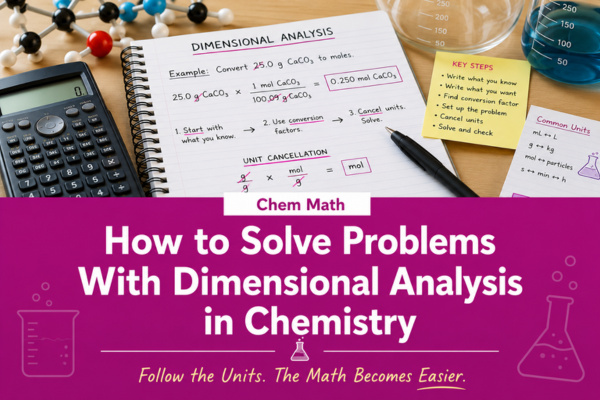
Here is the pattern students need to see:
The unwanted unit cancels.
The desired unit remains.
That is the entire goal of dimensional analysis in chemistry.
Chemistry Example: Grams to Moles
Now let’s apply this to chemistry.
Example:
Convert 36 grams of water to moles.
Step one:
Write what you know.
Step two:
Identify the conversion factor.
Water has a molar mass of:
Now set it up so grams cancel.
The grams cancel.
Final answer:
This is where many students begin realizing:
“Oh… this is really just organized setup.”
Exactly.
Watch the Full Video Tutorial
If your teen needs to see how to solve dimensional analysis problems in chemistry with the setup worked out step by step, I also have a video tutorial that walks through chemistry conversions visually.
Sometimes seeing the setup happen in real time helps the process click much faster.
Multi-Step Dimensional Analysis
This is where chemistry starts layering concepts together.
Example:
Convert grams → moles → particles
Students now need multiple conversion factors in one setup.
This is where organization becomes critical.
Dimensional analysis actually becomes easier when students keep everything connected.
The biggest mistake students make is trying to do each step separately in their head instead of building one continuous setup.
Common Mistakes Students Make
1. Flipping the conversion factor upside down
Students should always check:
Does the unwanted unit cancel?
2. Ignoring units completely
Students often focus only on numbers.
But the units tell students whether the setup is correct.
3. Skipping setup steps
This is the fastest way to get lost in chemistry math.
Writing every step actually saves time in the long run.
4. Trying to memorize instead of understanding
Students do not need to memorize every problem type.
They need to understand the structure.
Once the structure clicks, students can solve much more complicated chemistry problems.
How Parents Can Help at Home
You do not need to teach chemistry to support your teen here.
What helps most is slowing the process down.
Encourage your teen to:
Write every unit clearly
Show cancellation visually
Explain why units cancel
Talk through the setup before solving
This builds confidence much faster than rushing through worksheets.
Why Dimensional Analysis Matters So Much in Chemistry
Dimensional analysis is not just one topic.
It shows up everywhere.
Stoichiometry
Gas laws
Solutions
Thermochemistry
Molarity
AP Chemistry calculations
Students who become comfortable with dimensional analysis early often feel much more confident throughout the year.
That is why this is one of the first skills I recommend reviewing before high school chemistry and AP Chemistry.
Extra Support for Chemistry Math
If your teen needs additional practice, I have several resources that can help support dimensional analysis and chemistry math skills.
The free Chem Basics for AP Chemistry Study Guide includes review and practice problems covering chemistry math and foundational concepts.
I also have:
- self-paced chemistry review resources
- guided video lessons
- one-to-one tutoring for students needing extra help
Because in chemistry, organized thinking matters just as much as the answer.
Doc 🧡