Is Your Teen Ready for High School Chemistry this Fall?
If your teen is heading into high school chemistry this fall, you might be thinking:
They have seen this before in middle school.
They are strong in math, so they should be fine.
We will just see how it goes.
If you are wondering how to prepare for high school chemistry before the school year starts, you are asking the right question.
Let me gently tell you what I have seen year after year.
Chemistry has a way of sneaking up on students.
The year often starts off pretty smooth. The first few topics feel familiar. Atoms. Elements. Maybe even balancing simple equations. Students relax. Parents breathe.
And then…
The concepts begin to build.
And build.
And build.
They cannot learn something in September and forget it in October because it keeps showing up.
And that is even before the math fully hits.
Understanding this pattern is the first step when you are trying to prepare for high school chemistry in a way that truly helps your teen.
Let’s talk about what that really means and how you can prepare your teen for high school chemistry with confidence.
Why High School Chemistry Is Cumulative
One of the biggest reasons students struggle in chemistry is that it is cumulative.
Unlike some classes where units feel separate, chemistry is layered.
Atomic structure connects to periodic trends.
Periodic trends connect to bonding.
Bonding connects to molecular shape.
Molecular shape connects to intermolecular forces.
Intermolecular forces connect to thermochemistry.
Each concept leans on the previous one.
If a student never truly understood the mole, it will resurface in stoichiometry.
If stoichiometry is shaky, thermochemistry becomes harder.
If thermochemistry is unclear, equilibrium feels overwhelming.
This is why preparing for honors chemistry or standard chemistry before fall can make such a difference.
The foundation matters.
The Math Skills Needed for High School Chemistry
Parents often assume that if their teen is strong in algebra, they will automatically succeed in chemistry.
But chemistry introduces something different.
Applied algebra layered in chemical terms.
Students are suddenly asked to:
Rearrange formulas
Track units carefully
Work through multi-step proportional relationships
Round correctly using significant figures
Translate word problems into equations
They are not just doing math.
They are doing math wrapped in scientific language.
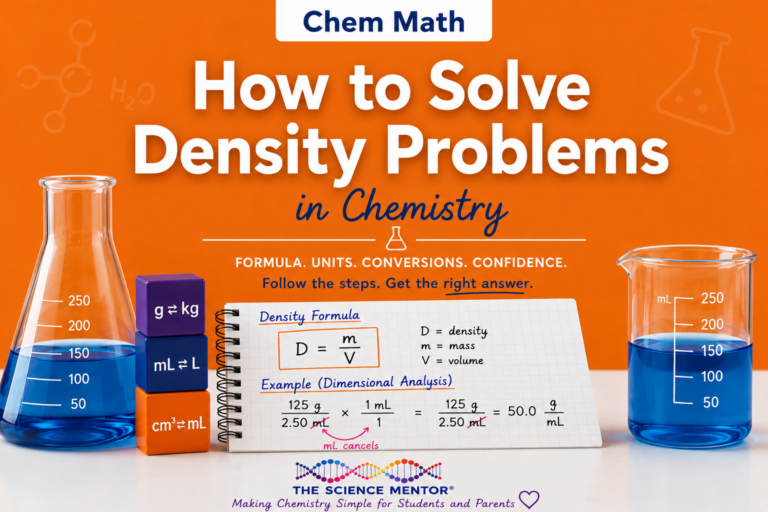
A simple density formula becomes confusing when units are grams per milliliter, comparing physical properties.
A basic proportion becomes overwhelming when it involves moles and coefficients.
The algebra is still the same.
The context changes everything.
This is why reviewing these math applications is one of the smartest ways to prepare for high school chemistry before the pace increases.
What to Review Before High School Chemistry Starts
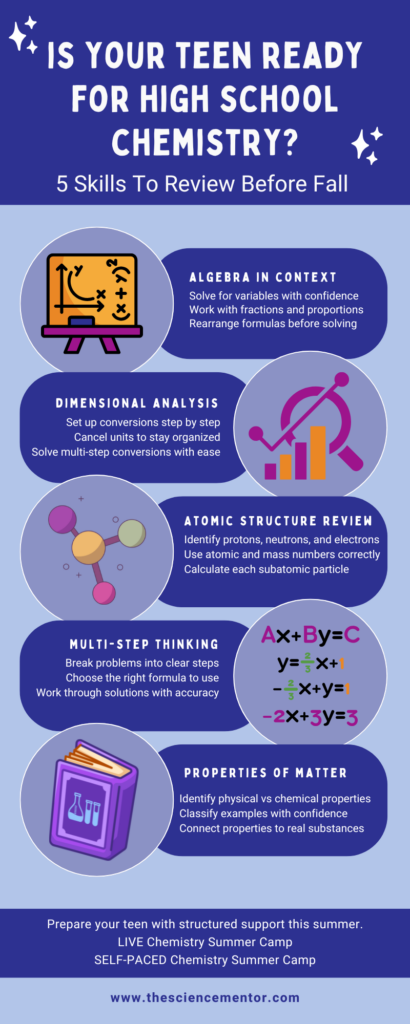
If you are looking for practical ways to prepare for high school chemistry, focus here
✔ Algebra in Context
Have your teen practice:
Do not stop at math worksheets.
Ask questions like, “If density equals mass divided by volume, how would you solve for mass?”
Have them explain it out loud.
Something happens when they have to explain a process they previously memorized. Like having to explain to someone how to tie your shoe! That explanation is the bridge between algebra and chemistry.
✔ Dimensional Analysis
This is one of the biggest confidence builders in chemistry.
Students struggle not because it is impossible, but because they have not practiced setting up conversions in a structured way.
Practice converting:
Have them write it as multiplication.
Have them cancel units visually.
This is important and will prepare them to convert chemical substances and units in a single problem.
Once they see the pattern, it clicks.
✔ Atomic Structure Review
Before students begin chemistry, they should feel comfortable with the structure of the atom.
This is something they have likely seen in middle school, but often need to revisit with more clarity.
Practice:
This may feel simple, but it becomes the foundation for everything that follows, including bonding, ions, and chemical reactions.
Keep it simple. Keep it consistent.
✔ Multi-Step Thinking
Chemistry problems often require more than one step.
Students must:
That sequence can overwhelm even strong students.
This structured thinking is what many students lack.
Practicing multi-step chemistry problems slowly over the summer helps build reasoning skills that transfer directly into the school year.
This makes it easier to prepare for high school chemistry at a deeper level.
✔ Physical and Chemical Properties of Amtter
This is one of the first content areas students encounter, and it often feels familiar at first.
But this is where many students begin to get tripped up.
Students may recognize terms like mass, volume, and density, but chemistry asks them to go deeper. They must identify, classify, and apply these properties in context.
The confusion usually starts when students need to distinguish between physical properties and chemical properties.
A physical property can be observed without changing the substance.
A chemical property describes how a substance can change into something new.
Students often memorize definitions but struggle to apply them.
You can practice this at home by:
This becomes even more important when density and other measurable properties are introduced, because now students must connect concepts with math.
Helping your teen clearly understand physical and chemical properties early is a simple but powerful way to prepare for high school chemistry.
Why Starting Strong Matters
Here is what typically happens.
August and early September feel manageable.
Students think this is not so bad.
By late September, the pace increases.
By November, they are juggling layered concepts and constant math application.
If there are gaps, they begin to feel it.
Because chemistry builds, small misunderstandings compound over time.
When we prepare for high school chemistry ahead of time, we’re not just reviewing content. They are building fluency before speed is required.
Preparation is not about doing more work.
It is about building fluency before speed is required.
Chemistry Review Videos for Summer Prep
If your teen works well with video instruction, I also have a short chemistry prep playlist that can help support their review over the summer.
The playlist includes four videos covering foundational topics like chemistry math, atomic structure, and other key concepts students often need before high school chemistry.
It is not a complete course, but it can be a helpful way to reinforce some of the topics in this plan before the school year begins.
A Simple Four-Week Prep Plan
If you want a clear plan to prepare for high school chemistry this summer, here is a simple structure.
Week One
Algebra refresher
Solve for variables daily
Practice proportions
Work confidently with fractions
Week Two
Atomic structure review
Identify protons, neutrons, and electrons
Use atomic number and mass number
Interpret simple atomic notation
Week Three
Properties of matter
Identify physical and chemical properties
Classify real-world examples
Connect properties to measurable characteristics
Week Four
Dimensional analysis and multi-step problem solving
Practice unit conversions daily
Cancel units and track work clearly
Work through multi-step problems step by step
Explain reasoning out loud
Short, consistent sessions are more effective than cramming.
Thirty minutes a few days per week is enough to improve readiness.
Preparation Is the Advantage
Chemistry does not usually overwhelm students on the first day.
It sneaks up.
It starts gently.
Then it layers.
Then it connects.
Then the math becomes constant.
But when students walk in already comfortable with algebra in context, dimensional analysis, the mole concept, and structured problem solving, they experience a completely different year.
Instead of catching up, they stay steady.
Instead of feeling surprised, they feel prepared.
And that changes everything.
When asking how to prepare your teen for high school chemistry, structured summer support can make all the difference.
If you want structured, guided preparation, my Chemistry Summer Camp walks students through the math and foundational chemistry concepts they will encounter in the fall, so they begin confident and steady. There’s also a self-paced version, allowing for more flexibility!
And if, as you are preparing, you begin to notice gaps or hesitation in certain areas, that may be a sign that more individualized support would help. I share more about recognizing those signs in my post on when to hire a science tutor.
Because in chemistry, starting strong matters!
Doc 🧡