
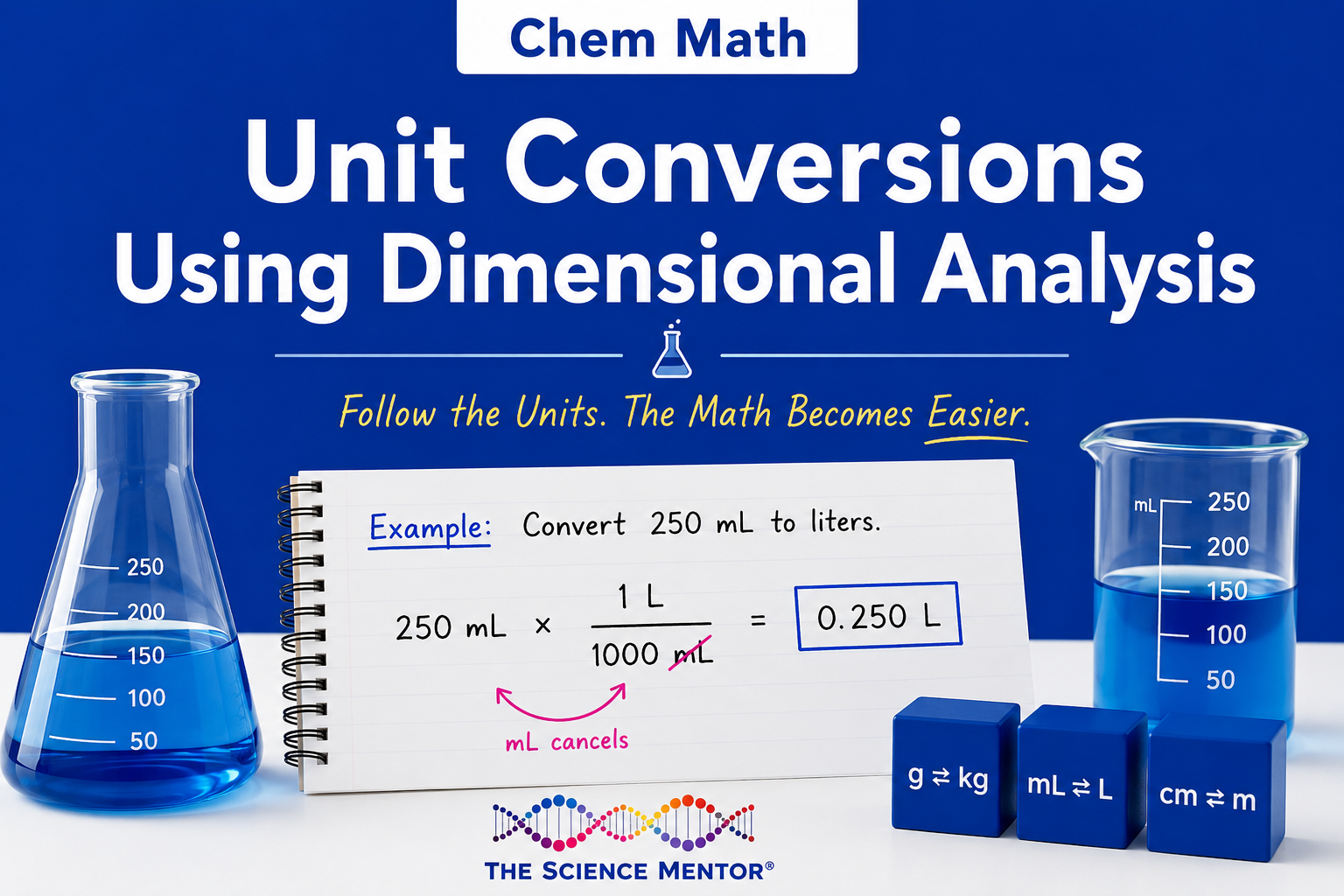
How to Solve Metric Conversions in Chemistry
Learning how to solve metric conversions in chemistry is one of the first places students begin applying dimensional analysis.
Once students understand the basic idea behind dimensional analysis, the next question is usually:
How do I know which conversion factor to use?
This comes up often when students begin working with the metric system in chemistry.
Should the 1,000 go on the top or the bottom?
Should the answer be larger or smaller?
And how do you know whether the setup is correct before reaching for the calculator?
The good news is that metric conversions follow a predictable pattern. You do not need a different trick for every problem, and you do not need to rely on moving the decimal and hoping it went in the right direction.
This blog is the next step in my chemistry math series. It builds on the dimensional analysis process and shows students how to apply that same setup to metric system conversions used throughout high school chemistry.
Let’s work through how that looks.
Why Chemistry Uses the Metric System
Chemists work with measurements that range from very large to extremely small.
A chemical sample may have a mass measured in kilograms, grams, or milligrams. Liquid volume may be measured in liters, milliliters, or even microliters.
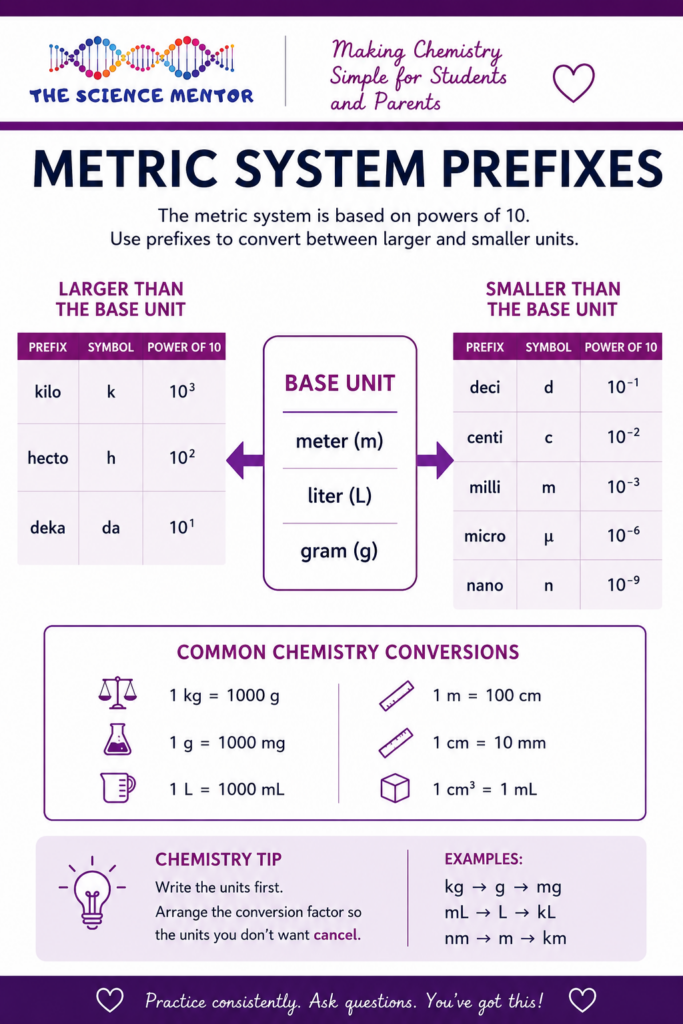
The metric system works well for science because each prefix represents a power of ten.
That means the relationship between units stays consistent.
For example:
1 kilogram = 1,000 grams
1 gram = 1,000 milligrams
1 liter = 1,000 milliliters
Once students understand what each prefix means, metric conversions in chemistry become much easier because students can build the correct conversion factor instead of trying to memorize where to move the decimal.
Metric System Prefix Chart
The base unit depends on what is being measured.
For length, the base unit is the meter.
For volume, the base unit is the liter.
For mass, chemistry commonly uses the gram.
How to Set Up Metric Conversions Using Dimensional Analysis
Before solving metric conversions in chemistry, identify three things:
- The unit you are starting with
- The unit you need in the answer
- The relationship between those two units
Then arrange the conversion factor so the unit you no longer want cancels.
This is the part students often rush.
But the setup is what determines whether the answer will be correct.
Every example below uses the same process for solving metric conversions in chemistry, so once students learn the setup, they can apply it to many different chemistry problems.
Example 1: Converting Milligrams to Grams
Problem: Convert 4,500 mg to grams.
Step 1: Write the Conversion Relationship
Before setting up the problem, write the conversion you know.
1,000 mg = 1 g
Step 2: Set Up the Dimensional Analysis
Start with the given measurement. Then place milligrams in the denominator of the conversion factor so the units cancel.
The mg units cancel, leaving g, which is the unit we need.
Step 3: Solve
Multiply across the top and divide by the bottom.
Answer
Does the Answer Make Sense?
Yes.
Grams are larger than milligrams, so the numerical value should become smaller. Since 4.5 is smaller than 4,500, the answer is reasonable.
Example 2: Converting Liters to Milliliters
Problem: Convert 2.4 L to milliliters.
Step 1: Write the Conversion Relationship
We know:
1 L = 1,000 mL
Step 2: Set Up the Dimensional Analysis
Start with the given measurement. Place liters in the denominator so the liter units cancel.
The L units cancel, leaving mL.
Step 3: Solve
Answer
Does the Answer Make Sense?
Yes.
Milliliters are smaller than liters, so it takes more milliliters to represent the same volume. The numerical value should become larger.
Example 3: Converting Centimeters to Meters
Problem: Convert 325 cm to meters.
Step 1: Write the Conversion Relationship
We know:
100 cm = 1 m
Step 2: Set Up the Dimensional Analysis
Start with the given measurement. Place centimeters in the denominator so the centimeter units cancel.
The cm units cancel, leaving m.
Step 3: Solve
Answer
Does the Answer Make Sense?
Yes.
Meters are larger than centimeters, so the numerical value should become smaller. Since 3.25 is smaller than 325, the answer makes sense.
Example 4: Converting Microliters to Milliliters
Problem: Convert 750 μL to milliliters.
Step 1: Write the Conversion Relationship
We know:
1,000 μL = 1 mL
Step 2: Set Up the Dimensional Analysis
Start with the given measurement. Place microliters in the denominator so the units cancel.
The μL units cancel, leaving mL.
Step 3: Solve
Answer
Does the Answer Make Sense?
Yes.
Milliliters are larger than microliters, so the numerical value should become smaller.
How to Solve Multi-Step Metric Conversions
Some metric conversions in chemistry require more than one conversion factor because the starting unit and the desired unit are on opposite sides of the base unit.
When that happens, convert to the base unit first.
For mass, the base unit is the gram.
For length, the base unit is the meter.
For volume, the base unit is the liter.
For example, when converting kilograms to milligrams, you must move through grams:
kilograms → grams → milligrams
Students may try to move the decimal several places at once, but that can make it easy to lose track of the direction or the number of places.
Instead, break the conversion into two steps.
First, convert from the starting unit to the base unit.
Then, convert from the base unit to the desired unit.
Here is an example.
Example 5: Converting Kilograms to Milligrams
Problem: Convert 3.6 kg to milligrams.
This conversion moves across the base unit, so we will convert from kilograms to grams first and then from grams to milligrams.
Step 1: Write the Conversion Relationships
We know:
1 kg = 1,000 g
1 g = 1,000 mg
Step 2: Set Up the Dimensional Analysis
Start with the given measurement. Arrange both conversion factors so each unwanted unit cancels.
The kg units cancel first. Then the g units cancel, leaving mg.
Step 3: Solve
Does the Answer Make Sense?
Yes.
Milligrams are much smaller than kilograms, so it takes a much larger number of milligrams to represent the same mass.
Example 6: Converting Nanometers to Meters
Problem: Convert 625 nm to meters.
Step 1: Write the Conversion Relationship
We know:
1 m = 1,000,000,000 nm
Step 2: Set Up the Dimensional Analysis
Start with the given measurement. Place nanometers in the denominator so the units cancel.
The nm units cancel, leaving m.
Step 3: Solve
Paste this into the WordPress math editor:
You can also write this answer in scientific notation.
Answer
Does the Answer Make Sense?
Yes.
A nanometer is much smaller than a meter, so the numerical value should become much smaller when we convert to meters.
An Important Chemistry Volume Conversion
Example 7: Converting Cubic Centimeters to Milliliters
Problem: Convert 28 cm³ to milliliters.
Step 1: Write the Conversion Relationship
For volume, cubic centimeters and milliliters are equivalent.
1 cm³ = 1 mL
Step 2: Set Up the Dimensional Analysis
Start with the given measurement. Place cubic centimeters in the denominator so the units cancel.
The cm³ units cancel, leaving mL.
Step 3: Solve
Answer
Does the Answer Make Sense?
Yes.
One cubic centimeter is equal to one milliliter, so the numerical value stays the same. Only the unit changes.
Can Students Just Move the Decimal?
When students first learn how to solve metric conversions in chemistry, many are taught to move the decimal.
The problem is that students often forget which direction to move it or how many places to go.
That confusion becomes more noticeable once chemistry problems include multiple conversions.
Dimensional analysis gives students a process they can continue using when the math becomes more involved.
Instead of asking:
Which way should I move the decimal?
Ask:
Which unit needs to cancel?
That question makes the setup much clearer.
Common Mistakes When Solving Metric Conversions
Putting the conversion factor upside down
Suppose a student writes:
The milligrams cannot cancel because they are both on top.
The correct setup is:
Before calculating, check the units.
If the unit you do not want does not cancel, turn the conversion factor over.
Assuming every conversion uses 1,000
Several common metric relationships involve 1,000, but not all of them.
For example:
Use the meaning of the prefix rather than assuming every metric conversion uses the same number.
Leaving the units out
The units are part of the calculation.
Writing them at every step helps students see whether the conversion factor is arranged correctly.
Forgetting the unit in the answer
A number without a unit does not tell us what was measured.
Always include the final unit.
How to Check Your Answer
Before moving on, ask:
- Did the starting unit cancel?
- Is the requested unit the only unit left?
- Should the number become larger or smaller?
- Does the final answer make sense?
When converting to a smaller unit, the numerical value usually becomes larger.
For example:
When converting to a larger unit, the numerical value usually becomes smaller.
For example:
This quick reasonableness check can catch mistakes before students move to the next part of a chemistry problem.
Where Metric Conversions Appear in Chemistry
Metric system conversions are not a separate skill students learn once and leave behind.
They appear throughout high school chemistry, including:
- laboratory measurements
- density
- molarity
- gas laws
- calorimetry
- mole conversions
- stoichiometry
A problem may give volume in milliliters even though the formula requires liters. A mass may be reported in milligrams when the next calculation requires grams.
Students need to complete the unit conversion before applying the chemistry equation.
That is why learning how to solve metric conversions in chemistry using dimensional analysis is such an important skill. The same process students learn here will be used throughout the rest of their chemistry course.
Continue the Series
Chemistry Calculations Made Simple
This blog is part of a chemistry math series that works through the calculations students use throughout high school chemistry. Each blog focuses on one type of problem and shows students how to work through it step by step.
✓ Part 1: How to Solve Problems with Dimensional Analysis in Chemistry
✓ Part 2: How to Solve Metric Conversions in Chemistry (You’re here.)
✓ Part 3: How to Solve Grams to Grams Stoichiometry Problems
□ Part 4: How to Solve Density Problems
□ Part 5: How to Solve Molarity Problems
As each new guide is published, I’ll add it here so you can continue building your chemistry problem-solving skills step by step.
You’ve Got This
Learning how to solve metric conversions in chemistry takes practice, but the process stays the same every time.
Start with the unit you have.
Choose a conversion factor that cancels that unit.
Then check whether your answer should be larger or smaller.
That is much more reliable than trying to remember which direction to move the decimal.
The more students write out the units and follow the setup, the easier these problems become. Those same steps will also help when they begin working with mole conversions, density, molarity, and stoichiometry.
Continue Learning
The next blog in this series will focus on how to solve mole conversions in chemistry, where you’ll use the same dimensional analysis process to convert between particles, moles, and mass.
If you’d like more practice with metric conversions and the other chemistry math skills covered in this series, here are two ways to keep learning:
Chemistry Math Essentials Study Guide
Looking for extra practice? The Chemistry Math Essentials Study Guide includes guided examples, additional practice problems, and detailed answer keys to help students build confidence with dimensional analysis, metric conversions, scientific notation, significant figures, and more.
→ Download the Chemistry Math Essentials Study Guide
Chemistry Math Essentials Course
If you want a complete, self-paced learning experience, the Chemistry Math Essentials course includes video instruction, interactive activities, guided practice, printable resources, and everything students need to build a strong foundation before moving into the rest of high school chemistry.
Doc 🧡
